
Human Antibody Sequencing from Serum
Motivation
Human antibody sequencing is a powerful tool for understanding the humoral immune response. Until recently, B cell-focused approaches have been the only available tool for understanding the diversity and plasticity of the antibody response to challenge (see review by Yaari & Kleinstein). Now, high-throughput mass spectrometry methods along with advanced computational tools have enabled a new perspective on the antibody response: serum antibody sequencing.
Two approaches exist for sequencing serum antiboodies: Proteogenomic Polyclonal Antibody Sequencing and De Novo Polyclonal Antibody Sequencing. In a recent blog post, we provide an overview of these methods, highlighting their workflows, applications, benefits, and limitations.
Proteogenomic polyclonal antibody sequencing approaches, such as Abterra Bio’s Alicanto, allow for sensitive querying of the serum protein repertoire by utilizing the matched B-cell repertoire. However, this limits detection only to those antibodies, and fragments, that appear in the cellular repertoire that was captured by next-generation sequencing (NGS). De novo polyclonal antibody sequencing, such as Abterra Bio’s Griffin, is unencumbered by the cellular repertoire in it’s search. However, it is less sensitive as the amount of signal required to identify a sequence without a template is higher.
The accessible repertoire recovered via proteogenomic and proteomic approaches can be depicted in the Venn diagram in Figure 1 below. Alicanto identifies the portion of the serum repertoire that overlaps the cellular repertoire, while Griffin enables sequencing of the antibody repertoire that was not sampled by NGS . Additional description on biological and B-cell subsampling limits can be found in our previous blog post.
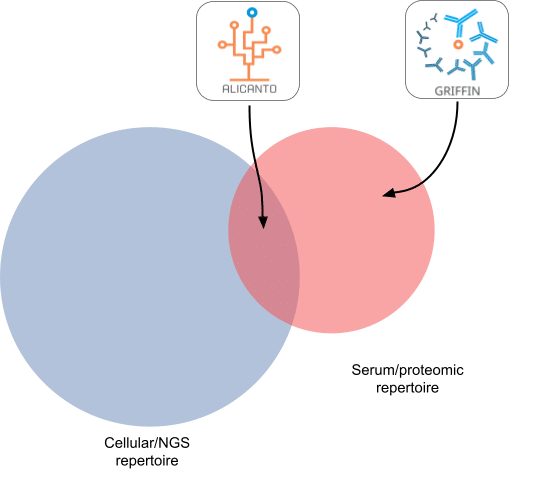
Figure 1: Alicanto proteogenomics vs Griffin de novo proteomics and the segments of the serum repertoire they can query.
So, one burning question remains: just how unique are the clones can only be found in the serum?
Methods
For this human antibody sequencing case study we revisit a dataset generated to identify neutralizing antibodies from the serum of convalescent patients that had recovered from SARS-CoV-2 infection (Patel et al). The study was summarized in a blog post. Our goal is to compare the antibodies identified by Alicanto (a proteogeonomic method) to antibodies identified by Griffin (a de novo sequencing method).
Briefly, whole blood was collected from there donors (AB2, AB5, and AB6). Each donor had previous exposture to both SARS-CoV-2 infection as well as vaccination (see Patel et al for details). The whole blood was seperated into plasma (containing circulating antibodies) and the buffy coat containing peripheral blood mononuclear cells (PBMCs). The SARS-CoV-2 Spike protein-reactive memory B cells were enriched from PBMCs and sequenced. Concurrently, IgG from plasma was enriched against Spike protein or receptor binding domain (RBD) and subjected to mass spectrometry analysis. Alicanto identified clones that were present in both the enriched IgGs as well as the memory B cells.
For the proteogenomic clones in this blog post, we re-used clones that we previously identified using Alicanto from Patel et al. The term ‘clone’ is refers to the amino acid sequence of the CDR3 of the heavy chain. We limit the analysis to CDRH3 sequences as they are more diverse than light chain CDR3 sequences, and are the primary drivers of antibody specificity.
To identify antibodies using a de novo proteomic approach, we used Griffin. Serum antibodies from the same donors were purified against wild-type SARS-CoV-2 RBD, and analyzed by Griffin. High confidence full CDRH3 sequences were identified and extracted for the comparison.
Results
Clonal Comparison
In order to visualize the clonal overlap both across donors and across human antibody sequencing methods, we create a network where each CDRH3 is a node, and two nodes are connected if they share 85% or more sequence similarity (Figure 2). Singleton nodes are shown on the periphery – disconnected from other nodes. Connected components are shown in the middle of the network.
Any node that is shared across donors or across methods is depicted as a pie-chart with the respective colors. We can see that there are six CDRH3s that are shared across donors, and two CDHR3s that are identified by both Alicanto and Griffin. These two co-identified clones had monoclonal antibodies that were characterized in-depth in Patel et al. That these were selected by Alicanto for validation and were found by Griffin is perhaps not surprising, as these both had very strong proteomic signals.
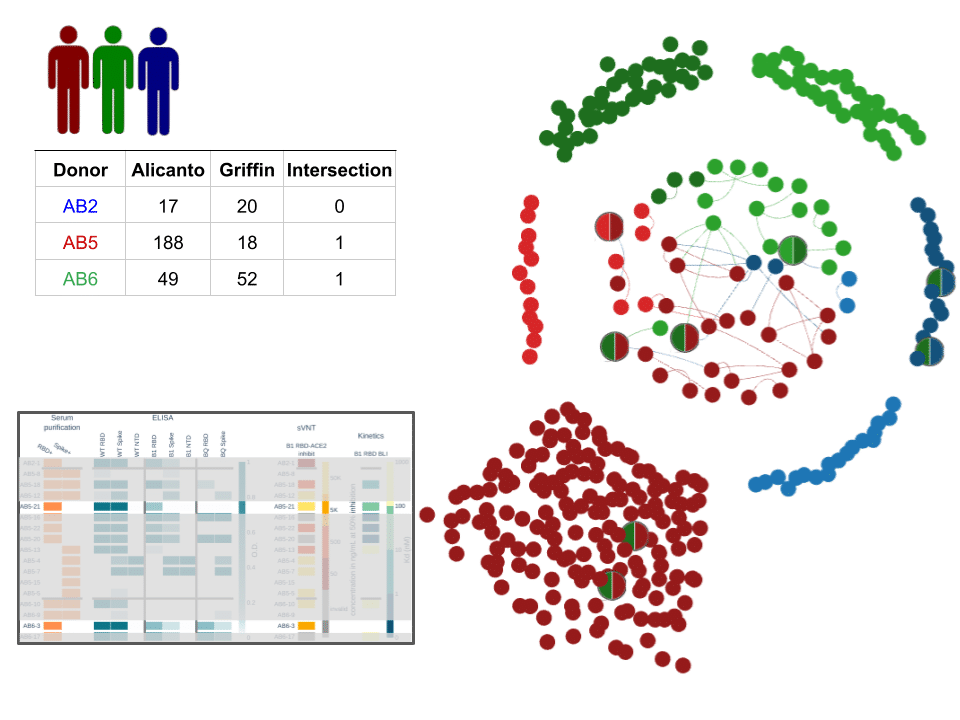
Figure 2: Alicanto CDRH3s shown in darker colors for each donor, Griffin CDRH3s shown as lighter colors. Pie-chart nodes are shared across Alicanto/Griffin or donors. Two CDRH3s found in both Alicanto and Griffin had previously characterized mAbs as part of Patel et al., 2025, highlighted in the figure from the publication.
Discussion
We analyzed three different serum repertoires represented from three different human donors purified against the RBD antigen. The CDRH3s were sequenced proteomically and compared to Alicanto identified CDRH3s from a previous study. We found little overlap between the Alicanto clones and Griffin clones.
- Two of three individuals had overlap between their CDRH3s identified from Alicanto (proteogenomics) and Griffin (proteomics)
- The two donors that had a single CDRH3 clone found both in Griffin and Alicanto accounted for:
- 1/18 =5.5% of clones found by Griffin in donor AB5 were also found by Alicanto
- 1/52 = 1.9% of clones found by Griffin in donor AB6 were also found by Alicanto
- These are both small numbers – similar to the 4.5% overlap we observed for camelid VHH CDRH3s previously.
Some points to consider regarding these overlaps and possible sources of divergence – two distinct purifications from the same source polyclonal were performed, one for each approach. Furthermore, the proteomics employed between Alicanto and Griffin are quite different, but given the same material should yield highly similar results.
We consistently observe only small overlap between the de novo proteomic CDRH3s identified by Griffin and those that overlap the cellular repertoire with Alicanto. This suggests that Griffin is able to identify a significant number of clones not present in the cellular repertoire – both enabling recapitulation and characterization of polyclonals when no B-cell material is available, but also in maximizing the clonal capture even when available.

Rabbit pAb Sequencing
Griffin is species-agnostic, and can be used to sequencing polyclonal antibodies from other species – including rabbit like we did in a recent case study.

VHH Antibody Discovery
B cells and serum antibodies provide complementary information about the immune response. Our Alicanto platform combines B cell repertoire sequencing and serum antibody analysis to deliver diverse, functional VHHs.

Griffin vs Alicanto
What’s the different between serum-only antibody sequencing with Griffin and proteogenomic antibody sequencing with Alicanto? We investigate the advantages and trade offs of each approach in this blog post.